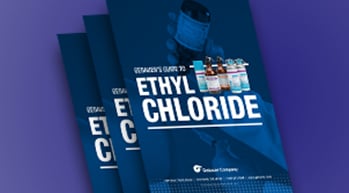
FAQs- Gebauer's Ethyl Chloride®

Including Accu-Stream 360™

with Sure Lock Technology™

1.) How does Gebauer’s new ACCU-STREAM 360 with Sure Lock Technology differ from other Gebauer Ethyl Chloride products?

2.) What type of procedures can all of Gebauer’s Ethyl Chloride products be used for as a topical anesthetic refrigerant spray?

3.)
How does Gebauer’s Ethyl Chloride work? What is its mechanism of action?

4.)
Can Gebauer’s Ethyl Chloride be sprayed directly on medical devices such as PICC lines, IV tubing, or ports?

5.)
Are there any special warnings or precautions that I should be aware of when using ACCU-STREAM 360 with Sure Lock Technology?

6.)
If the product is accidentally sprayed in the eyes, what should I do?

7.)
What are the ingredients in Gebauer’s new Accu-Stream 360?

8.)
How cold is Gebauer’s Ethyl Chloride spray?

9.)
How long do I spray Gebauer’ Ethyl Chloride on the treatment site?

10.)
How do I know the site is numb?

11.)
How long does Gebauer’s Ethyl Chloride anesthetic effect last?

12.)
When does Gebauer’s Ethyl Chloride get applied?

13.)
Is Gebauer’s Ethyl Chloride sterile?

14.)
Can Gebauer’s Ethyl Chloride be used in a pediatric population?

15.)
Can Gebauer’s Ethyl Chloride be used in a pediatric population?span>

16.)
Are Gebauer’s Ethyl Chloride products flammable?

17.)
What makes Gebauer’s new Accu-Stream 360 unique?

18.)
When the Accu-Stream 360 can is almost empty, will it continue to function?

19.)
What is the purpose of the locking ring (Sure Lock Technology) on Accu-Stream 360?

20.)
What should I do if the locking ring on Accu-Stream 360 will not open?

21.)
What should I do if Gebauer’s new Accu-Stream 360 can will not spray?

22.)
What is the propellant in all of Gebauer’s Ethyl Chloride products?

23.)
How long is the expiration date of Gebauer’s Ethyl Chloride?

24.)
Can I use Gebauer’s Ethyl Chloride with ultra sound or electrical cautery?

25.)
How many applications are in a bottle or can?

26.)
How cold is Gebauer’s Ethyl Chloride compared to Gebauer’s other skin refrigerants?

27.)
What is the toxicity of ethyl chloride?

28.) Does Gebauer’s Ethyl Chloride have an odor?

29.) Does Gebauer’s Ethyl Chloride need to be stored in a fireproof cabinet?

30.) How do I dispose of expired Gebauer’s Ethyl Chloride?

31.) Why is Gebauer’s Ethyl Chloride bottle more expensive than the can?

32.) Does Gebauer’s Ethyl Chloride need to be refrigerated?


1.) How does Gebauer’s new ACCU-STREAM 360 with Sure Lock Technology differ from other Gebauer Ethyl Chloride products?

Gebauer’s new ACCU-STREAM 360 with Sure Lock Technology differs from other Gebauer’s Ethyl Chloride products in its unique delivery system, but the contents remain the same. The can may be sprayed at any angle…upright, upside down, and any angle in between. Accu-Stream is available in both a medium and fine stream aerosol can.
 

2.) What type of procedures can all of Gebauer’s Ethyl Chloride products be used for as a topical anesthetic refrigerant spray?

Ethyl Chloride can be used as a pre-injection topical anesthetic before an injection such as: IM (intramuscular) or subcutaneous injection, immunization, IV start, venipuncture, or lidocaine injection. It is also indicated for use to control pain before minor surgical procedures such as I & D of small abscesses, lancing boils, and the treatment of paronychia. Ethyl Chloride is not indicated for use on open wounds or mucous membranes.

Ethyl Chloride is also used as a counterirritant to treat myofascial pain, trigger point release, muscle tension, and restricted motion. It is also indicated for contusions and minor sports injuries like bruises, minor sprains, and minor swelling. Ethyl Chloride is easier to use than applying an ice pack to an injured area because it is immediately available, there is no mess like an ice pack, and the cooling effect is immediate. 


3.) How does Gebauer’s Ethyl Chloride work? What is its mechanism of action?

Ethyl Chloride is a topical aerosol anesthetic skin refrigerant. When topically applied to the skin, Ethyl Chloride creates an instantaneous cooling effect on the surface of the site by immediate evaporation of the product. The coldness created by the spray interrupts the body’s ability to experience pain.

This happens because the coldness decreases the nerve conduction velocity of the C fibers and A-delta fibers that make up the peripheral nervous system. This interrupts the nociceptive (stimuli to the brain giving rise to sensations of pain) inputs to the spinal cord. This process temporarily numbs that area. The fast evaporation rate is created by Ethyl Chloride and its unique delivery system.


4.) Can Gebauer’s Ethyl Chloride be sprayed directly on medical devices such as PICC lines, IV tubing, or ports?

Gebauer’s Ethyl Chloride is not indicated for spraying on any medical device, such as PICC lines, IV tubing, or ports. A wide variety of materials are used in the manufacture of medical devices available today. Gebauer Company lacks compatibility information that would support the use of Ethyl Chloride on the materials in these medical devices, and is therefore not recommended. Gebauer’s Ethyl Chloride should only be sprayed on intact skin.


5.) Are there any special warnings or precautions that I should be aware of when using ACCU-STREAM 360 with Sure Lock Technology?

Gebauer’s new Accu-Stream 360 sprays from the top; be careful not to spray it in your eyes or the eyes of a patient. Never unintentionally aim towards the face.
In addition to these, note the standard precautions associated with the product (see Question 16). For full prescribing information, visit www.gebauer.com, click onto Resources, MSDS & Technical Details.


6.) If the product is accidentally sprayed in the eyes, what should I do?

You should immediately flush eyes thoroughly with warm water for at least 15 minutes. Hold the eyelids open and away from the eyeballs to ensure that all surfaces are flushed thoroughly. See a physician, preferably an ophthalmologist, immediately. Please report all incidences to Gebauer Company’s Customer Service Department.


7.) What are the ingredients in Gebauer’s new Accu-Stream 360?
The ingredient in Gebauer’s new Accu-Stream 360 is ethyl chloride. It is the same ingredient used in all other Gebauer’s Ethyl Chloride products.


8.) How cold is Gebauer’s Ethyl Chloride spray?

The temperature of the product will vary due to the delivery system (fine stream, medium stream or mist spray) as well as the distance from which the product is sprayed (see Question 9). Since Gebauer’s skin refrigerants work by evaporation, the faster the product evaporates from the surface of the skin, the colder the cooling effect will be. The cooling effect of the stream lasts longer than the mist due to the lowered evaporation rate of the chemical from the point of contact. Mist spray produces very fine droplets of product that are dispersed over a larger area than the stream sprays, and evaporates very quickly, creating an instantaneous cooling effect at the point of contact.

Temperature data has been collected on all Gebauer products, across the range of labeled spray distances. The temperature studies were performed using validated laboratory equipment to measure the various temperatures. The medium stream products range in temperature from around 2°C at 3 inches to -3°C at 9 inches. The spray of the fine stream product has a temperature of around 0°C at 3 inches to -3°C at 9 inches. The mist spray reaches a temperature of approximately -4°C at 3 inches away from the point of contact. 


9.) How long do I spray Gebauer’s Ethyl Chloride on the treatment site?

Spray Ethyl Chloride to the site for 4 to 10 seconds from the can and 3 to 7 seconds from the bottle or until the skin just turns white. Both the can and bottle should be sprayed from a distance of 3 to 9 inches away from point of contact. The length of time that you spray will depend on the skin’s sensitivity to cold, plus a number of variables such as differences in blood flow, sensory perception, weight, fat content, metabolism etc. The practitioner needs to be observant while spraying. When the skin begins to turn white, the numbing has taken effect and it is time to stop spraying. Do not frost the skin. Spray in a well-ventilated area.


10.) How do I know the site is numb?

When the skin begins to turn white in the center of the spraying area, or you have reached 10 seconds, the skin is sufficiently cold enough to numb the area.


11.) How long does Gebauer’s Ethyl Chloride anesthetic effect last?

The anesthetic effect of Ethyl Chloride lasts up to 60 seconds.


12.) When does Gebauer’s Ethyl Chloride get applied?

Applying Ethyl Chloride should be the last thing done before performing the procedure. Follow protocol when cleaning the area with an antiseptic, have all equipment ready for the procedure and then apply Ethyl Chloride immediately before performing the procedure.


13.) Is Gebauer’s Ethyl Chloride sterile?

Ethyl Chloride does not claim to be sterile, but the product has passed the Microbial Limit Test in accordance with The United States Pharmacopeia (USP) <61>. These tests are designed to demonstrate that a substance is free from Staphylococcus aureus (staph), Escherichia coli (E-coli), Pseudomonas aeruginosa and Salmonella species. Tests also measure total bacteria, mold, and yeast growth.


14.) Can Gebauer’s Ethyl Chloride be used in a pediatric population?

Ethyl Chloride has a general approval and can be used on children, as well as adults. Published clinical trial results support the use on children three years of age and older.

It is important to note that when using Ethyl Chloride on a child, the practitioner needs to be very observant as to when the skin blanches and not over spray. A child’s skin may be more sensitive to the cold temperature than an adult’s. The cold spray may also startle the child and it is good practice to warn them that the product is cold, prior to spraying, although this may be difficult at a young age.


15.) Can Gebauer’s Ethyl Chloride be used for circumcision?

No. There are no clinical trials to support the efficacy of using Ethyl Chloride for circumcision. Ethyl Chloride has not been approved for use on genital or oral mucous membranes.


16.) Are Gebauer’s Ethyl Chloride products flammable?

Ethyl Chloride is flammable and should never be used in the presence of an open flame, hot surface, or electrical cautery equipment. The vapors are also flammable.


17.) What makes Gebauer’s new Accu-Stream 360 unique?

Gebauer’s new Accu-Stream 360 sprays from the top of the can, at any angle… from upright, to upside down, and any angle in between. 


18.) When the Accu-Stream 360 can is almost empty, will it continue to function?

When the can is almost empty, the last sprays will only exit the can when the can is in an upright position.


19.) What is the purpose of the locking ring (Sure Lock Technology) on Accu-Stream 360? 

The safety locking ring serves multiple purposes. Most importantly, it will help prevent accidental spraying when the can is not in use. The locking ring replaces an over cap and prevents accidental spraying during shipping. 


20.) What should I do if the locking ring on Accu-Stream 360 will not open? 

If the locking ring won’t open, firmly grip the can in one hand and rotate the locking ring in the opposite direction. This should open the locking ring. If you are still having trouble please contact Gebauer Company’s Customer Service Department.


21.) What should I do if Gebauer’s new Accu-Stream 360 can will not spray?

Make sure the locking ring is open by turning the blue locking ring counterclockwise in the direction of the OPEN arrow. If the locking ring is open, and still not spraying, check the content level of the can, by giving it a shake, to make sure the can is not empty. If you are still having trouble please contact Gebauer Company’s Customer Service Department.


22.) What is the propellant in all of Gebauer’s Ethyl Chloride products?

There is no added propellant, Ethyl Chloride acts as its own propellant.


23.) How long is the expiration date of Gebauer’s Ethyl Chloride?

Ethyl Chloride bottles have a 3-year expiration date and all Ethyl Chloride cans have a 2-year expiration date. The expiration date on the bottles is located on the back of the label, next to the UPC code. The expiration date on all cans is located on the bottom of the can.


24.) Can I use Gebauer’s Ethyl Chloride with ultra sound or electrical cautery?

Gebauer’s Ethyl Chloride should never be used with or around electrical cautery equipment, since Ethyl Chloride is flammable. The vapors are also flammable.

It is not recommended to use Gebauer’s Ethyl Chloride bottle around ultra sound equipment since the vibration could cause the bottle to shatter. Use Gebauer’s Ethyl Chloride can with ultra sound equipment, since there is no hazard of the can breaking due to vibration. 


25.) How many applications are in a bottle or can?

When using Ethyl Chloride for pre-injection anesthesia or to control pain associated with minor surgery, there are approximately 40 to 50, 5-second spray applications per bottle or can.

When being used to treat myofascial pain, muscle spasm, or minor sports injury, or in conjunction with the spray and stretch technique, it is hard to predict how many applications are in one container, since each application for these types of procedures will use a different quantity of spray, depending on how long the area is sprayed and the size of the affected area. 


26.) How cold is Gebauer’s Ethyl Chloride compared to Gebauer’s other skin refrigerants?

Gebauer’s Ethyl Chloride, Gebauer’s Pain Ease® and Gebauer’s Spray and Stretch® have equivalent cooling profiles. 


27.) What is the toxicity of ethyl chloride?

When used as directed, in a well-ventilated setting, Gebauer’s Ethyl Chloride is well below an exposure level that would cause concern of toxicity.

There is published toxicity data on ethyl chloride, but this data is associated with high dosing and chronic exposure levels to ethyl chloride. This is not reflective of the intended use of Gebauer’s Ethyl Chloride products. When Gebauer’s Ethyl Chloride is used as intended, the long-term toxicity due to exposure is low. Exposure is further limited by the nature of the use of Gebauer products as a vapocoolant. Since the product is applied in short, topical sprays, in a well-ventilated area, it quickly evaporates with little to no absorption into the skin. 


28.) Does Gebauer’s Ethyl Chloride have an odor?

Yes, Ethyl Chloride has a slight odor. The room that it is being used in should be well ventilated. You may also notice a slight white residue on the skin, after spraying the product.


29.) Does Gebauer’s Ethyl Chloride need to be stored in a fireproof cabinet?

Even though Ethyl Chloride is flammable, it does not need to be stored in a fireproof cabinet. However, each hospital and office may have its own protocol that requires special storage of flammable products. It is up to the individual institution to decide where to store Ethyl Chloride.


30.) How do I dispose of expired Gebauer’s Ethyl Chloride?

Ethyl Chloride needs to be disposed of in accordance with your facility’s hazardous waste program. This applies to bottles and cans that are empty or have product remaining in the container.


31.) Why is Gebauer’s Ethyl Chloride bottle more expensive than the can?

The bottle packaging is more costly to produce. The bottles have nozzles and valves that are assembled individually by hand, therefore making them more expensive. The plastic coating on the bottle adds to the additional expense of the bottle over the can.


32.) Does Ethyl Chloride need to be refrigerated?

No, Ethyl Chloride should not be refrigerated.


*Please refer to the prescribing information found either on the bottle carton or can insert for further technical information as well as a full identification of all warnings, precautions and contraindications for Gebauer’s Ethyl Chloride products.


1.) What types of procedures are appropriate to use Pain Ease as a topical anesthetic skin refrigerant spray?

2.) How does Pain Ease work? What is the mechanism of action?

3.) How long do I need to spray Pain Ease on the procedure site?

4.) How do I know the site is numb?

5.) How long does Pain Ease last?

6.) When do I apply the Pain Ease?

7.) Do I have to apply more antiseptic to the site after applying Pain Ease?

8.) Is Pain Ease sterile?

9.) Can I use the same can of Pain Ease on different patients?

10.) Do I need to be concerned about cross contamination when using Pain Ease on different patients?

11.) Can I reapply Pain Ease?

12.) Are there any contraindications for Pain Ease?

13.) Can I use Pain Ease on an open wound?

14.) Does Pain Ease numb deeper than the top, cutaneous layer of skin?

15.) What is the toxicity of Pain Ease?

16.) Is Pain Ease flammable?

17.) Which Pain Ease application do I use? Pain Ease mist or Pain Ease stream?

18.) Can I use Pain Ease with cautery equipment?

19.) Can I use Pain Ease with laser equipment?

20.) Can I use Pain Ease for pre-injection anesthesia before accessing a port?

21.) Can Pain Ease be sprayed directly on other medical devices such as PICC lines, IV tubing or ports?

22.) Can Pain Ease be used prior to liquid nitrogen for the removal of warts, particularly on children?

23.) Can Pain Ease be used for sclerotherapy (a cosmetic procedure where an injection is made to diminish the appearance of spider veins)?

24.) How many applications will I get from one 3.5 oz. can?

25.) How much does Pain Ease cost?

26.) What are the active ingredients of Pain Ease?

27.)  How do I dispose of Pain Ease?


1.) What types of procedures are appropriate to use Pain Ease as a topical anesthetic skin refrigerant spray?

Pain Ease can be used as a pre-injection anesthetic before an injection such as: IM or subcutaneous injection, immunizations, IV starts, venipuncture, cosmetic injection or lidocaine injection. It also can be used before minor surgical procedures such as I & D, foreign body removal or suturing. Pain Ease can be used in conjunction with ultrasound, x-ray, laser equipment or cautery (see Question 18).


2.) How does Pain Ease work? What is the mechanism of action?

Pain Ease is a topical aerosol anesthetic skin refrigerant. When topically applied to the skin or intact oral mucous membranes, Pain Ease creates an instantaneous cooling effect on the surface of the site by immediate evaporation of the product. The coldness decreases the nerve conduction velocity of the C fibers and A-delta fibers that make up the peripheral nervous system. This interrupts the nociceptive (stimuli to the brain giving rise to sensations of pain) inputs to the spinal cord. This process temporarily numbs that area. The fast evaporation rate is created by Pain Ease’s chemical blend and its unique delivery system*.


3.) How long do I need to spray Pain Ease on the procedure site?

Spray Pain Ease to the site for 4 to 10 seconds from a distance of 3 to 7 inches until the skin begins to blanch. The length of time will depend on the skin’s sensitivity to cold plus a number of variables such as differences in blood flow, sensory perception, weight, fat content, metabolism etc. The practitioner needs to be observant while spraying. When the skin begins to turn white, the numbing has taken effect and it is time to stop spraying. Do not frost the skin.


4.) How do I know the site is numb?

When the skin blanches or begins to turn white in the center of the spraying area, the skin is sufficiently cold to numb the area.


5.) How long does Pain Ease last?

The anesthetic property of Pain Ease lasts for up to 60 seconds.


6.) When do I apply the Pain Ease?

Applying Pain Ease should be the last thing done before doing the procedure. Follow protocol when cleaning the area with an antiseptic, have all equipment ready for the procedure and then apply the Pain Ease immediately before doing the procedure.


7.) Do I have to apply more antiseptic to the site after applying Pain Ease?

Follow your individual protocol as to application of an antiseptic, however, it is not necessary to reclean the site after applying Pain Ease. (Refer to Question 8)


8.) Is Pain Ease sterile?

Pain Ease does not claim to be sterile but the product has passed the Microbial Limit Test in accordance with the USP. These tests are designed to demonstrate that a substance is free from Staphylococcus aureus, Escherichia coli, Pseudomonas aeruginosa and Salmonella species*.


9.) Can I use the same can of Pain Ease on different patients?

Yes, because the can does not come in direct contact with the site (it is held between 3 to 7 inches from the site) it can be used between individual patients. Also, the design of the aerosol can and valve does not allow the ingress of substances into the can.


10.) Do I need to be concerned about cross contamination when using Pain Ease on different patients?

No, because the can does not come in direct contact with the site (it is held between 3 to 7 inches from site) it can be used between individual patients without cross contamination. The design of the Pain Ease valve is such that it does not allow any type of substance to enter its opening.


11.) Can I reapply Pain Ease?

Yes, Pain Ease can be reapplied per directions, as needed, if a procedure takes longer than anticipated.


12.) Are there any contraindications for Pain Ease?

Pain Ease is contraindicated for patients who have a history of hypersensitivity to 1,1,1,3,3- Pentafluoropropane and
1,1,1,2-Tetrafluoroethane. If skin irritation develops, discontinue use. Consult the product insert, found in the cap, for a full listing/identification of all contraindications, warnings, precautions and adverse reactions.


13.) Can I use Pain Ease on an open wound?

Yes, Pain Ease is indicated for minor open wounds, intact mucous membranes (nasal passages, lips and oral cavity) and skin. There is no systemic toxicity.


14.) Does Pain Ease numb deeper than the top, cutaneous layer of skin?

No, Pain Ease is a topical spray and affects only the surface of the skin.


15.) What is the toxicity of Pain Ease?

There is no systemic toxicity associated with Pain Ease. It is also non-ozone depleting and non-flammable. Refer to the Technical Data report for results of the toxicity studies.


16.) Is Pain Ease flammable?

No. Pain Ease is not flammable. Pain Ease is non-ozone depleting and has no systemic toxicity. It can be used in conjunction with ultrasound, x-ray, laser equipment and cautery (See Question 18).


17.) Which Pain Ease application do I use? Pain Ease mist or Pain Ease stream?

Using the mist or stream is a personal choice of the practitioner. They both are topical anesthetic sprays. However, Pain Ease mist is most effective for cooling the site where precise contact is not needed. The area covered is larger than the stream, approximately the size of a quarter. Because it is a mist, the evaporation rate is increased and there is more intense cooling in that area.

The Pain Ease stream is most effective for cooling a pinpoint area. Gebauer Company recommends the mist to be used for a pre-injection anesthetic or for minor surgery procedures, but it is the choice of the practitioner.


18.) Can I use Pain Ease with cautery equipment?

Yes, since it is non-flammable, Pain Ease can be used with cautery equipment. When using cautery equipment, special care should be taken to determine that the product has completely evaporated from the surface of the site to prevent possible decomposition due to extreme heat*.


19.) Can Pain Ease be used with laser equipment?

Yes, Pain Ease is non-flammable and can be used as a topical anesthetic prior to minor surgical procedures using laser equipment.


20.) Can I use Pain Ease for pre-injection anesthesia before accessing a port?

Yes, Pain Ease may be used for pre-injection anesthesia before accessing a port. (Follow your facility’s particular protocol.) Follow the application directions for pre-injection anesthesia (See Questions 3, 4, 5 and 6). Be aware that skin covering a port may be more sensitive and may respond more rapidly to the cold temperature of Pain Ease. Be observant when applying Pain Ease. Gebauer’s Pain Ease should only be sprayed on the skin covering the port, not directly on the port itself (See Question 21).


21.) Can Pain Ease be sprayed directly on other medical devices such as PICC lines, IV tubing or ports?

Gebauer’s Pain Ease is not indicated for spraying directly on any medical device, such as PICC lines, IV tubing or ports. Pain Ease is compatible with a variety of materials that are used to manufacture some medical devices. However, the large number of medical devices available today use a wide array of materials. Gebauer Company lacks compatibility information that would be all inclusive of every medical device material, so spraying on any medical device is not recommended.


22.) Can Pain Ease be used prior to liquid nitrogen for the removal of warts, particularly on children?

No, Pain Ease should not be used prior to liquid nitrogen for the removal of warts in any patient population. There is no clinical data to support this indication, therefore it is unknown if there would be any adverse effects from using liquid nitrogen (cryotherapy) on skin already exposed to a skin refrigerant like Pain Ease.


23.) Can Pain Ease be used for sclerotherapy (a cosmetic procedure where an injection is made to diminish the appearance of spider veins)?

Yes, Pain Ease can be used for pre-injection anesthesia prior to sclerotherapy injections and is covered under approved indications for Pain Ease use (Refer to Questions 3, 4, 5, and 6).


24.) How many applications will I get from one 3.5 oz. can?

Approximately 50 applications are produced when spraying for an average of 5 seconds per application.


25.) How much does Pain Ease cost?

The cost of Pain Ease will vary depending on the distributor you purchase it from and the amount used on each patient. Cost per application is approximately 40 to 50 cents per 5-second application.


26.) What are the active ingredients of Pain Ease?

The active ingredients of Pain Ease are 1, 1, 1, 3, 3-Pentafluoropropane and 1, 1, 1, 2-Tetrafluoroethane.


27.) How do I dispose of Pain Ease?

Pain Ease is an aerosol, which contains no hazardous materials. Therefore, it can be disposed of via ordinary disposal methods per your facility. Empty, partially empty or full containers with functioning valve systems may be disposed of through normal collection systems such as landfills. If the product does not have a functioning valve system, contact Gebauer Company for return instructions. The EPA recommends, but does not require, that an aerosol should be empty of product before placing in a landfill. Pain Ease should not be punctured or incinerated.


*Please refer to technical data sheet and prescribing information for further technical information
  about 
Gebauer's Pain Ease.


© Gebauer Company 2012   |    Privacy Policy    |    Terms of Use    |    Site Map